Показаны сообщения с ярлыком in English. Показать все сообщения

воскресенье, 27 ноября 2016 г.

Alexander Dugin: Traps and dead ends of the new nationalism


Fundamental failure of globalist version of liberalism is now evident. Brexit, Trump's victory and then elsewhere. But in its place comes the simplest solution: a return to national State (Etat-Nation) and to various forms of nationalism. That means we return - mutatis mutant - to the beginning of the twentieth century.

Realism in the international relations (+ mercantilism and protectionism in economy) is almost guaranteed and it will become soon the ideology of the political Centre (with some delay needed to cleanse the last Liberals). Welcome into a new era of nationalism. Second political theory (communism) is so discredited by the history of the twentieth century that it could hardly represent an alternative - even when it is deeply impregnated by liberal virus. Now there is no more clean communism -- rather far left liberalism in form of anarchism and trozkiism backed by such ultra-liberals as Soros. But nationalism is relatively forgotten. Its excessive demonization by the "anti-fascists" has made it look any meaning. The whole story of the name-calling "Nazis" of Putin and then - and this is important - of Trump finally has fully desemanticized the term - soon the word "fascist" will mean only the obscenity and will loose its sense completely. And the essence of nationalism, not the name, will come back and will be established everywhere, as simplistic alternative to the liberal hegemony, that is falling apart before our very eyes.

But did we want that issue? If someone wanted this, then that where'n't certainly us.

понедельник, 17 февраля 2014 г.

Evola on Monarchy


In the analysis of the range of the various arguments adopted in favor of monarchy, Loewenstein tried to be objective, but was unable always to be so. The precise aversion to every principle of true authority is quite visible in him, while an insufficient emphasis is given to the factors of an ethical and immaterial character. Now we believe that if you were forced to conceive of a monarchy only in an empty and democratized form, besides only being possible because it concerns marginal small states, not yet involved in the dynamism of the great forces of the era, we undoubtedly might as well end the discussion in the negative.
It must be recognized, however, that pessimistic conclusions regarding monarchy appear largely justified only if you hypostatize the situation of the current world and believe that it is irreversible and destined to continue itself indefinitely. This situation is defined by a general materialism, the prevalence of base interests, the egalitarian error, the government of the masses, technocracy, and the so-called “consumer society.” Except that we are beginning to multiply the signs of a profound crisis of this world of affluence and counterfeit order. Various forms of revolt are already noticeable, for which it is not impossible that it could reach a state of tension and a breaking point, and that, especially in the face of possible liminal situations, tomorrow different forms of sensitivity may be reawakened, reactions occurring similar to those an organism is capable of when it is mortally threatened in its deepest being.
The supplanting, or to a lesser extent, of this new climate is the decisive element also for the problem of monarchy. In our opinion, it should be placed in the following terms: What meaning could monarchy have in the case that such a change in climate should take place, and in what form could it be a center for the reconstitution of a “normal” order — normal in a higher sense? Certainly, the presence of a true monarchy in a nation would have a rectifying power, but this is a vicious circle: without the premise that we mentioned, any restoration would have a contingent, not organic and, in a sense, unnatural character.
The disorder present in the political field, everything that it shows of instability, dangerously open to subversion — to Marxism and communism — substantially derives from the deficiency of a superior principle of authority and from an almost hysterical impatience for such a principle, through which certain political experiences of recent times serve at most as a convenient alibi. Speaking of a superior principle of authority, we refer to an authority that has an actual legitimacy and, in a certain way, a “transcendent” character, because without this, authority would lack any basis, it would be contingent and revocable. A truly stable center would be missing.

вторник, 28 января 2014 г.

Mikhail Moshkin: Being Who We Are

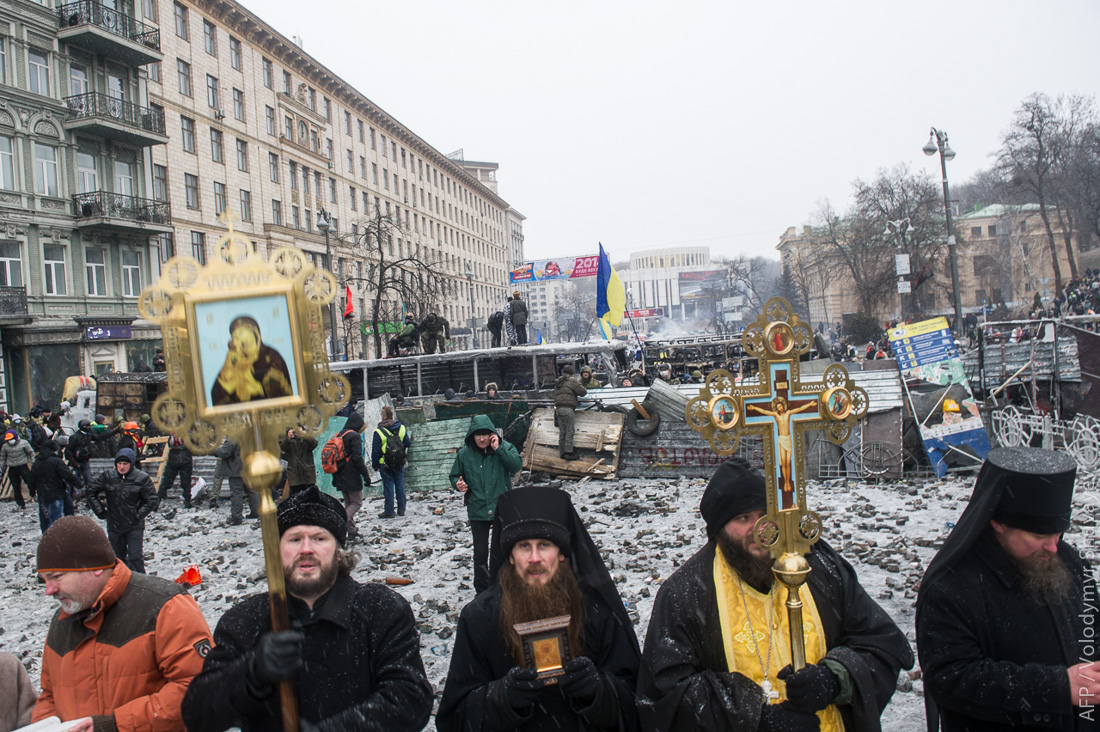
Russian journalist Mikhail Moshkin analyzes the current instability in Ukraine with a special focus on the meaning of traditional Russian identity and statehood. Translated by Nina Kouprianova.

The state is the actuality of the ethical Idea. It is ethical mind qua the substantial will manifest and revealed to itself, knowing and thinking itself, accomplishing what it knows and in so far as it knows it. (Hegel)

Ukraine: Two Alternatives of Returning to One and the Same

A well-known formula, “the patient is either alive or dead,” encapsulates the Ukrainian situation in its entirety for those looking from the outside (and, most likely, the participants themselves). Either the Maidan finally topples Viktor Yanukovich over, or, a more likely scenario in light of the current events is that Yanukovich will give up everything he possibly can, handing out status positions in the government to the Maidan triumvirate, which is rapidly losing popularity for collaborating with “zlochinna vlada”—“criminal authorities” (offending Oleg Tyagnibok to top it off!). And, considering that it is impossible to return to the pre-Maidan status quo, Yanokovich will become a “lame duck,” with the 2004 Constitution in his beak and the omnipotence of the Verkhovna Rada. In a country that just collapsed into yet another economic and political pit.

Given the prospect of Vitali Klitschko’s presidency (yet how can the boxer become president if Yulia Tymoshenko is released?), the prospect of a “white-and-blue” regional separatism, the secession of Crimea, etc., are all real possibilities. We are seeing the signs thereof already. At the same time, all our political scientists and analysts should not get overly excited about “redrawing the new underdeveloped countries on the map.” The specter of the Donetsk-Krivoy Rog Fronde haunted Ukraine as early as 2004 as well, but even then, with Viktor Yushchenko’s victory (does anyone still remember this political figure?), the southeastern autonomous region did not come to fruition, whereas Yevgeniy Kushnarev, the chief ideologue of separatism, got off lightly. Most likely, despite the ever-present antagonism between Galicia and the Southeast, there won’t be a “divorce.”